I was going to wait to publish this post until after I’d had time to read it through. But given that I just accidentally posted it, freaked out, made it private, I’m realizing that folks who got it through email will be able to read the entire thing anyway. SO. Here ya go. With a temporary title that obviously will be the permanent title – my ramblings and thoughts regarding Ebony Wilkerson, tragically better known as the mom in Daytona who drove her minivan into the sea.
The public defender’s office said there was a reason she beat her stomach. “She {is} being held in seclusion naked in her cell,” said Craig Byer.
Public defender James Purdey at first asked for Monday’s hearing to get Wilkerson’s 1.2 million bond reduced.
Purdey instead asked his client be transferred from the Volusia County Branch Jail to a psychiatric ward for longer than a typical Baker Act hold, so she can get mental pre-natal care.
The judge did not rule on the request to move Wilkerson because the judge said it’s something that hasn’t been done before. (Source)
According to the Ebony Wilkerson narrative we have thus far, she drove to Central Florida from South Carolina to escape an abusive partner. Her family struggled to get her help but she signed herself out of the hospital and somehow managed to get the keys to the minivan and drive it and all of her children into the ocean despite the family’s efforts to hide the keys from her.
This week, we are told she has been held naked, in seclusion at the local jail and started punching her stomach, causing her defenders to push for her to be moved to a psychiatric ward for “mental pre-natal care.”
What the hell is wrong with this picture?
From an emotional and advocate standpoint, a lot.
From a logical standpoint, I can understand why these measures may need to be taken, particularly if Ebony has been suicidal. Of course you don’t want to give her anything that she could possibly harm herself with but there has to be a way to do that without completely stripping her down and removing all sense of dignity, something she was more than likely running low on if indeed she was escaping an abusive relationship.
The judge’s reluctance to move her may also be grounded in logic as well. Perhaps she did not feel she had enough facts to justify setting a precedence with Ebony’s case. Or perhaps the Volusia County Jail has the capability to be considered as “clinically appropriate” (as is required of examination/treatment in the Baker Act) and therefore the judge did not see moving her as a necessity. Or perhaps there simply wasn’t anywhere to move her to which offered the same level of security the judge felt Ebony requires at the moment.
But when examined from an emotional and advocate point of view, this is absolutely heartbreaking.
A pregnant mother, escaping an alleged abusive relationship, drives her kids into the ocean despite attempts to help her. To me, this screams of absolute desperation. This is beyond sanity. It’s more than a call for help. This type of behaviour requires action.
But is what Volusia County doing enough?
How do we best handle this type of situation in this day and age?
It’s like I tell my kids and my partner – we can’t fix a problem unless we know about it. Unfortunately, women (and men especially) who are in abusive relationships are often quiet about their situations until it’s almost too late, and some until it is too late. Why? Because they are often threatened by the perpetrator that if they don’t remain silent, there will be repercussions.
Silence is also a hallmark of Perinatal Mood & Anxiety Disorders for multiple reasons. Society believes we should be happy when pregnant or in the throes of new parenthood. Thing is, mood disorders have been happening since the dawn of time. Our responses to them over the centuries have varied but even early on, a few folks got it right. Take Asclepiades, for example. According to Thomas Millons Masters Of The Mind, he “argued against dark cells and dungeons for the mentally ill…thought patients should be in settings that were well lit and comfortable.” Asclepiades also proposed that “biological and chemically based treatment would be beneficial” in addition to dividing conditions into acute versus chronic and also distinguished between hallucinations, delusions, and illusions.
The main point of Asclepiades is that even in the early ages (171-110BC, by the way), someone recognized that locking away the mentally ill in dark, dank places was NOT the way to go.
Arataeus believed the “soul was the basis of psychic disturbances” and “mental disorders were exaggerated normal processes”. (Millon)
Then there’s Soranus who posited “consider(ing) culture as a factor in both investigating and treating mental patient.” (Millon, Masters Of The Mind). He also advocated for decent and kind treatment of the mentally ill, asking “his peers to remember who was ill; physicians should not view their patients as disagreeable persons who offended their self-image.” (Millon) It seems to this outside observer that Volusia County is not doing that in Ebony’s case.
Does being an abused woman or a woman at the hands of a Perinatal Mood Disorder excuse the type of behaviour Ebony Wilkerson has exhibited? No. But both are mitigating factors which led to her behaviour and should absolutely be taken into consideration as her case proceeds.
I’ve written extensively about Postpartum Depression as a defense. Cases like these are both fascinating and heartbreaking because all at once, those of us who have experienced a Perinatal Mood & Anxiety Disorder, see fractions of ourselves in the women who make headlines. We collectively gasp and think, my God, what if I had given into all those thoughts racing through my head? I could be her. I could be Ebony. I could be Miriam, I could be Andrea, I could be Otty.
We shudder because we were there, with them, in the dark, in the hell, holding their hands and they fell as we watch in horror. The way their fall is paraded in front of society scares the crap out of us and drives many to silence. Is this healthy for society? Yes and no. We should be outraged when children are subjected to death (or the threat thereof) at the hands of their parents. But at the same time, we need to take steps to prevent this type of situation from occurring in the first place.
How do we do that when every single case, every single situation from mother to mother and from birth to birth is different? How do we catch a falling mother if we don’t know she is falling?
Even if we start by putting measures in place to check for signs of falling, we will still fail if the mother doesn’t admit to having a problem or, as in Ebony’s case, refuses help (for whatever reasons – cultural stigma, fear, etc) which is offered to her because she is far past the breaking point and sees death as the only way out. Do we just throw our hands up in the air and let her do what she may? No. So what do we do then?
I don’t know.
What I do know is this:
- Mothers (and fathers) do not deserve to be alone in this battle
- Mothers (and fathers) deserve emotional support
- Mothers and fathers need a village
- Perinatal Mood & Anxiety Disorders are not deserving of whispers, they require shouts
- We need to speak up, every single time, not just when there is a crisis
- Accept those who are hurting with open arms and provide a safe space for them to fall apart
- Not judge those who have/are struggling so harshly
So what can we do to improve the situation for struggling parents across the globe with the very real (and often co-occurring) issue of domestic abuse/violence and Perinatal Mood & Anxiety Disorders?
- Make it okay to reach out for help and ditch the supermom/superwoman/superman/superdad façade
- Initiate requirements for ALL health professionals who may come in contact with an expecting or new mother to be well-versed in the ins and outs of a Perinatal Mood & Anxiety Disorders (this includes pediatricians, OBGYN’s, GP’s, Family Doctors, IBCLC’s, doulas, midwives, naturopaths, you get my point…)
- Create local, state, and national referral networks which incorporate above said training on a regular basis
- Create networks of parents willing to mentor other parents through these tough situations and make it easy to access across the board
Are these solutions going to fix our current problem? No. But they’re a start and sadly, most of it revolves around a tradition which our current technologically advanced society has strayed greatly from – the tight knit expanded family. It takes a village to raise a child but it also takes a village to raise a mother to raise a child right. In my post “On Not Wanting To,” I state the following:
Our village is in peril. Our village? FELL THE FUCK APART AND NO ONE GIVES A DAMN.
In America, we have a pitiful excuse for maternity leave. We are bombarded by stories of celebs who gave birth and look AHMAZING in less than three weeks after giving birth. We are insanely comparing ourselves to women who are a) genetically blessed and b) have crazy access to things like trainers, nutritionists, nannies… and then there are the way we compare ourselves to each other. Stupid idiotic milestones of when we went back to work, how much we manage to get done every day, pushing ourselves to be better than the next mom and still have it all pulled together.
It’s no wonder we are screaming out for help and some of us are doing so through extreme measures.
Let’s keep the “if I were her, I would” out of the conversation. We do not know what she’s going through. Even if we’ve been through hell ourselves, we do not know *her* hell nor should we take her story as one which portends the downfall of ALL women who struggle with domestic violence/abuse and a Perinatal Mood & Anxiety Disorder. Instead, reach out to mothers, to fathers, let them know it is okay to reach out for help. For that matter, teach it to your kids so that when they get older they don’t feel as if reaching for help is in essence, failure to handle something on their own. Yes, independence is a grand thing but there is a time and a place to lean on someone else. Not to lean in, but to lean on, sometimes for dear life.
Our village has forgotten how to do this very simple yet necessary human act. We are now expected to be everything to everyone and dear GOD help us if we are not. Should we assume something is wrong with every mother? No. But instead of oohing and ahhing at her baby, ask how she’s doing. Ask how Dad is doing. Do not dismiss their very real role in their new situation. By acknowledging them, you acknowledge their existence and empower them to express their feelings. And that, my friends, is possibly one of the most powerful things we can ever do for a new parent.
Will it keep more pregnant women from being held in seclusion, naked in a prison cell, after they’ve attempted to kill their older children and themselves? Not all of them, no. But it’s a start.
An even better start would be to continue educating people about Perinatal Mood & Anxiety Disorders, including those in the law enforcement and legal arena. I realize they are bound by the courts and must adhere to the law but if they had a better understanding of the facts behind Perinatal Mood & Anxiety Disorders, perhaps, at least, the treatment of mothers imprisoned for crimes committed whilst experience these disorders would stand a chance of improving.
In the meantime, I genuinely hope that Ebony Wilkerson receives the help she so desperately needs as she awaits trial for her actions on the fateful day she drove her minivan into the sea. We’re watching, Volusia County. Don’t fail us more than you already have failed Ebony.



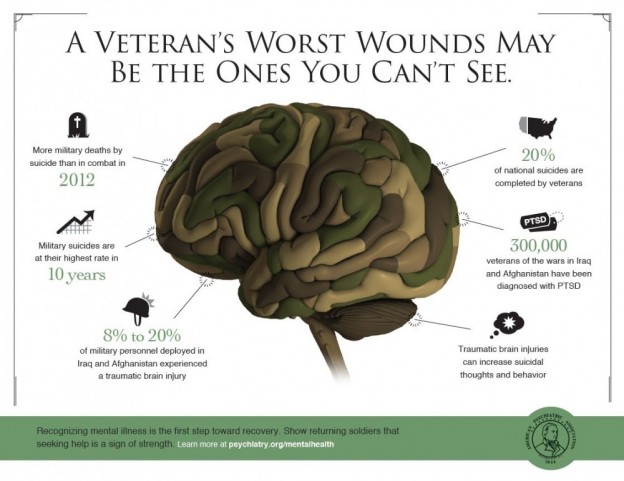
 Suicide rates among soldiers, for the first time ever, outnumbers the deaths occurring in active combat.